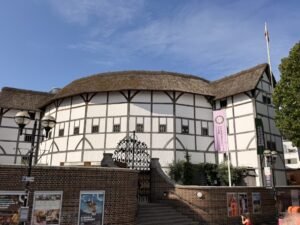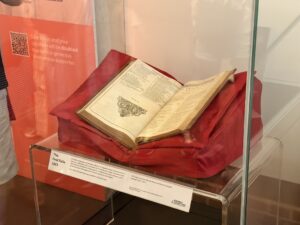
We visited The Globe Theater yesterday — the third iteration of Shakespeare’s Globe after the first burned down in 1613 (thanks to a cannon shot in the midst of a show) and the second one was torn down by the uptight Puritans of London in 1644.
It was unexpectedly emotional for me.
I fell in love with Shakespeare in high school after reading “Hamlet” in my tenth-grade English class. Quietly, I started reading Shakespeare as a teenager and young adult, struggling to find copies of his plays in an age when you couldn’t simply click and purchase texts online. I’d wander the aisles of Walden Books at the mall, hoping to find a play I had not read yet.
When I finally made it to college and began studying English, I dove into Shakespeare with all my soul. I see the plays performed onstage whenever possible, in any way possible.
I remember watching a version of Hamlet set in a Star Trek universe in an outdoor theater in upstate New York and thinking, “It’s still Shakespeare.”
Then, when I became a teacher in 1999, teaching second grade for a year, third grade for nine years, and fifth grade for 17 years, I taught my students Shakespeare. I read novelizations of the plays. They read the original text of specific plays and scenes, dissecting, debating, and performing them.
And for the first 20 years of my teaching career, thanks in part to the support and guidance of Plato Karafelis, my students performed full Shakespearean productions, first on the school’s stage and then on the stage I built in my classroom, complete with curtains, stage lights, a sound system, sets, props, and so many costumes.
They were glorious shows. I have a lifetime of stories from those performances that could fill a book, and maybe someday, they will.
The pandemic forced the removal of my stage for social distancing, and two years later, administrators refused to return my stage, citing the danger of an elevated platform in the classroom, despite the fact that the stage had been in the classroom without incident for two decades and music rooms and many other classrooms across the district had elevated platforms in their spaces.
Even worse, those same administrators refused to answer my phone calls, emails, and one registered letter asking for a meeting on the subject.
It’s one of the great saddnesses of my teaching career. Watching my students perform on stage was the highlight of every school year, and truly, it was the highlight of theirs as well. The pandemic brought that to an end for two years, rightfully but tragically so, but then people who refused to dignify me with a response and treat me like a professional stole the magic and joy from my classroom at the end of my career for no discernible reason.
Still, we studied Shakespeare despite the loss. We acted out scenes in class and read the original text and debated important questions like:
“Who was really to blame for the death of Romeo and Juliet?”
“Who was more of a monster? Macbeth or Lady Macbeth?”
“Was Hamlet a hero or a putz?”
“Is Iago Shakespeare’s greatest villain?”
“How many times can people fall asleep in a glade without seeing each other?”
Over the years, my students gifted me so many Shakespeare-related objects, toys, and books, including at least a dozen books on The Globe:
Historical accounts
Picture books
Comic books
Enormous pop-up books
I still have them all. The first was given to me 25 years ago by a student named Kelly Hires who had visited The Globe with her family and returned with a book explaining the theater’s history and Sam Wannamaker’s ceaseless desire to rebuild it.
But truly, for most of my life, seeing The Globe with my own eyes seemed impossible. As a younger person, traveling to London was impossible. The cost alone would never allow for it. When you grow up in a small world, with very little means, a trip across an ocean to a place like London never seems like a possibility.
Later, when I was struggling to survive, the dream of someday visiting Shakespeare’s home was the last thing on my mind. When you’re homeless and hungry, international travel is never a thought in your mind. Then later, managing McDonald’s restaurants while putting yourself through college, any travel that doesn’t include your car and a tank of gas seems ridiculous.
Even after I started teaching, the idea of flying to London for a vacation seemed silly. For a decade, Elysha stayed home with the kids, and while my publishing career and DJ company made that possible, we spent years barely furnishing our home as we instead plowed our money into our children’s futures.
A trip to London was a luxury we could not envision.
Miraculously, things have changed for us over the past decade. My new, inexplicable, unintentional, almost accidental career has made it possible for us to do things we could not do before.
So yesterday, after a lifetime of never thinking it would happen, I stepped into The Globe and stood in a space that I have only studied in books for so many years.
I didn’t expect to become emotional, but I did. Sometimes you can’t know how much you yearn for something until it finally, unexpectedly arrives. You protect your heart from the dream lest it never come true, so when it does, the walls that you’ve built around that dream fall so suddenly that you are consumed with that brilliant combination of joy for the moment you’re finally standing in and sadness for the hopelessness that once was.
That was me, yesterday, taking my first peek at The Globe.
It was exactly how I had always envisioned it.
Exactly how I thought it would be.
But of course it was. I had been looking at images, drawings, pictures, photographs, and architectural schematics of the theater for almost three decades. I had never been to the theater, but I had seen that theater on paper and in my dreams for a long, long time.
I knew that theater like the back of my hand.
Yesterday, I had a chance to see it with my own eyes.
Shakespeare’s Prospero, once played by the great Roxanna Barbera on my classroom stage, said,
“We are such stuff
As dreams are made on.”
That line meant more to me yesterday than ever before.