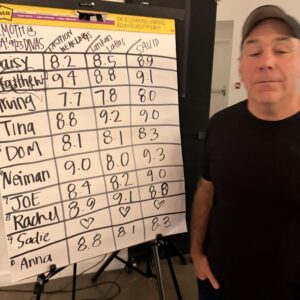
I won a Moth StorySLAM last week in New York City — my 65th victory.
I’ve been telling stories for The Moth for a long time. Back in July, I celebrated my 15th year as a Moth storyteller. I’ve competed in 121 StorySLAMs, 38 GrandSLAM championships, and 6 Mainstage shows.
I’ve been onstage a lot. I’m ancient in Moth years. Practically a dinosaur.
Maybe closer to a fossil.
I am often asked, “Why are you still doing that? Don’t you get paid to speak now?”
But no matter how many times I’ve performed for The Moth, I still learn something from competing, which is perhaps one of the best things about the long drives and uncertainty about whether I will be chosen to perform.
I always get a little better.
On this particular night, my name was drawn second, which annoyed me. Recency bias makes it harder to win when chosen earlier in the show, though it’s certainly possible. In the last four Moth StorySLAMs, my name has been drawn first twice and second twice.
Not ideal.
Still, you can win from these early positions, as I proved that night. If you tell a great story, it doesn’t matter when you take the stage.
I was leading at intermission but expected to be beaten in the second half when a man approached me.
“You’re going to win tonight,” he said.
“Don’t be so sure,” I told him.
I explained that I knew a couple of excellent storytellers here tonight, and who knows? We could have a talented rookie among us. I also pointed out that it’s only human nature to forget what you heard earlier in favor of what you’re hearing now.
Recency bias. It’s real.
“Someone could easily take me down in the second half,” I said.
“Nope,” he said. “You’re going to win.”
I asked him why he was so sure.
“Because you flipped us twice.”
“I flipped you?” I asked. I had no idea what he meant.
“Yup. You flipped us twice. Maybe even three times, now that I think of it. First, you made us laugh. We were all having a great time. Then, in almost an instant, you broke our hearts. All the humor was gone in the blink of an eye. You flipped us. Then a minute later, you brought us back from the brink. Surprised us again. Unbroke our hearts. Put our hearts back together. Flipped us again. That’s when I knew you were going to win. I never saw any of that coming. No one did. You flipped us. Twice. It was like a magic trick.”
That’s pretty close to exactly what he said to me, because as soon as we were done speaking, I typed his words into my phone as best as I could remember because I thought he’d just given me an outstanding explanation of what all great stories require:
A flip.
A magic trick.
What I think of as surprise.
Surprise is the most delightful thing a storyteller can offer an audience, regardless of the context:
Page. Stage. PowerPoint. Keynote. Song. Commercial. Lesson. Social media post.
Surprise is everything. It’s why we tell stories, or at least it should be. Lots of things make a story worth our time, but surprise stands above them all.
It’s why so many stories, presentations, pitch decks, social media posts, and keynotes fall flat. Rarely do people try to surprise. They somehow think that the content alone will carry the day.
Content is not king. Craft is king. And surprise is the best expression of craft.
I loved what that man said:
“I never saw any of that coming.”
I could receive no greater compliment about a story, at least when it comes to the craft. I’m obsessed with surprise. It’s the most entertaining, unforgettable element of any story ever told. It’s the best, and often, the only way to produce an emotional response from an audience.
I think about a lot of things when I tell a story. More things than you might believe. Storytelling is nothing more than decision-making. The storyteller who makes the most thoughtful decisions, and the most decisions, is almost always the champion.
But standing above all of those decisions, more important than humor, stakes, suspense, transitions, pacing, momentum, characterization, vocabulary, imagery, nuance, and everything else, is surprise.
Or, in the words of my fellow storyteller:
A flip. A magic trick.
I like both of those ideas. New ways of thinking about an old concept.
As a teacher, I know that the more ways you can express an idea, the better your chances of mastering it yourself and teaching it to others.
That storyteller gave me two new ways of thinking about surprise that night.
One turned surprise into something almost physical. A muscular response to sound.
The other removed surprise from the world of storytelling and placed it in an entirely different realm.
Think like a magician.
Both helped me think of surprise in a new way, and perhaps present it to clients and students in a new way, too.
That’s why I return to The Moth again and again, despite the long drive, the uncertainty about being chosen, and the lack of any financial compensation.
I get something well worth my time and effort:
I get better.
I satisfy a relentless, purposeful desire to improve. The recognition that I have so much room to grow. The certainty that I don’t even know what I don’t know. The faith that anyone, on any given night, can teach me something new.
I also just love telling stories.