In 1989, I moved out of my childhood home and into a townhouse in Crystal Village in Attleboro, Massachusetts, with my friends Bengi and Tom. We called our home The Heavy Metal Playhouse, and for the next three years, we had a lot of fun while living in poverty and perpetual uncertainty.
Tom would move out in less than a year after losing his job and running out of money, leaving just Bengi and me, but the fun never ended.
Huge parties.
Sunday night Simpsons and 90210 watch parties.
Thousands of hours spent trying to master video games.
Epic pillow fights.
A constant stream of friends and friends of friends, visiting, drinking, hooking up, sleeping on couches, and engaging in occasional mayhem.
It was glorious.
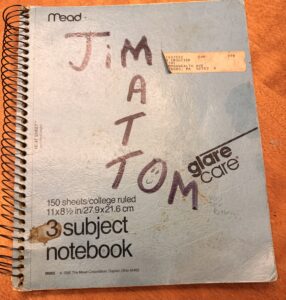
On day one in our new home, Bengi created a communication log:
A wire-bound notebook, kept by the door, where we left notes for one another. Sort of an analog version of texting, which was important back then.
Tom worked a 9-5 warehouse job.
Bengi was a student at Bryant College and was working at a nearby McDonald’s in the evenings.
I was managing a McDonald’s in Milford, Massachusetts. On any given day, I could open the store in the predawn hours, work a brutal 11:00 AM-7:00 PM shift, or go in late in the afternoon to close the store.
Though we spent loads of time together, we were also often like ships passing in the night.
The notebook helped us keep up with things.
Bengi preserved the notebook after The Heavy Metal Playhouse came to an end. In the summer of 1993, he moved to Connecticut for a job, and I became homeless as I awaited trial for a crime I did not commit.
But happily, he kept the notebook for all these years.
He passed the notebook to me last year, and with Tom’s death last month, I decided it was time to make my way through its pages.
The cover was cleverly designed by Bengi and features a mailing tag that reads:
Juan Croucier
Box TH1
3 Commonwealth Ave
Attleboro, MA 02703
That’s our address at the time, of course. Juan Croucier was the bass player for the band Ratt, which Bengi loved. Bengi was also trying to learn to play the bass at the time. Somehow, he arranged to have something mailed to our home with Juan Croucier’s name on it.
The inside cover of the notebook contains a message, written in marker, from Bengi. It reads:
“This is a message book, so we know what’s going on if we ain’t around.”
Then he signed the message using his real name, Jim.
Then he added:
“PS: Conserve paper. We’re poor. Writing big doesn’t make it any different to read.”
Bengi has always been frugal. Even with notebook paper back in 1989.
The first page contains some interesting moments. It consists of a long note written by Bengi, dated December 11, 1989. He time-stamped the note, too:
1:29 AM.
A late night for us.
It’s addressed to Tom. Bengi and I had spent the day and night organizing our new home (I remember that day well), and he wanted Tom to know what we did and what was expected.
Tom was not the neatest or most conscientious roommate ever. He needed a lot of reminders.
The first line reads: “Living room is awesome. Eh?”
I love this. We had a living room made up mostly of hand-me-down furniture, a couch we found on the side of the road, an ancient coffee table, and a small television perched atop an old baby changing table.
Yet we were so excited.
Other lines that I love:
“We used the dishwasher.” Another moment of pride.
“We need an organ.” This refers to an organ I planned to take from home since no one in my family ever played it. Bengi’s mocking was sensible. The organ lasted less than six months before we finally tossed it.
Three teenage boys do not need an organ.
There’s a series of motherly suggestions to Tom that become a theme throughout our time with Tom. Tom was terrible with money. He spent everything he had, and he lacked self-control of any kind. Apparently, Bengi was already worried about this tendency. In his note, he writes:
“You can have the brownie in the fridge.
I got you a lunch bag.
Make your sandwiches!”
There’s also a circled addendum in the margin that reads “Eat your bagels.”
Bengi was trying to help Tom save money by bringing lunch to work and eating what was available.
Lines I do not quite understand:
“We need more reading material.”
Huh? We admittedly read quite a bit back then and would often pass around books, but the desire for more reading material on day one is odd.
“ALF is staying downstairs.”
The only ALF I know is the alien from the 1980s sitcom, but I don’t recall an ALF doll in our home. I checked with Bengi, and he has no idea what this reference means, either.
It’s apparently lost to time.
My favorite line of all is this:
“Try to see if the UHF works on the black and white”
I read this line to Charlie and Clara and asked if they understood it at all.
“What’s the context?” Charlie demanded.
“The context is contained in the sentence,” I said. “Do you know what it’s referring to?
He had no idea. Neither did Clara. When I told them that it was a reference to our black-and-white TV, perched atop the aforementioned baby changing table in our living room, Clara said, “You owned a black-and-white TV? Why?”
She thought it was some bespoke choice on our part rather than an indication of our meager means.
In case you also don’t understand the references, we owned a black-and-white TV that still received a television signal over the airwaves. The VHF antenna was a rabbit-ear-shaped metallic rod on the back of the TV, and the UHF antenna was a round metallic circle. This was because VHF and UHF waves were different lengths and therefore required different antenna shapes.
VHF signals were also much stronger than UHF signals, so Bengi wanted to know if we could receive any UHF channels on our TV.
Eventually we would get cable, but that was a bit down the road.
I spent ten minutes showing my kids what these old-fashioned televisions looked like, pulling up photos online. Charlie, a fan of analog technology (he’s now building a collection of CDs and cassette tapes to play in his CD/cassette player), looked like he might want one of these ancient TVs for himself.
In the top margin of the page is this circled message:
“Leave book with bunny.”
Though we would eventually own rabbits that lived like cats in our home (including using a litter box), this indicates where to keep the notebook. It may refer to Sebastian, a stuffed bunny my high school girlfriend gave me two years earlier, and who I later had an infamous night of adventures with alongside a bottle of Peppermint Schnapps.
I don’t remember those adventures, but Bengi tells me they were hilarious. Sebastian and I apparently had a lot of fun.
The note ends with the words “Turn page,” meaning Bengi may have added a PS after signing it.
But I’m taking this notebook slowly.
Savoring every minute of this walk down memory lane.
I’ll turn the page tomorrow and see what wonders it holds for me.
Mostly, I’m just happy to have it. It’s a window into my past. A glimpse into my life more than 35 years ago when I was living on my own for the first time, absent any safety net or adult wisdom of any kind.
Three young men, still teenagers, trying to live on their own with very little money, oftentimes very little heat, but a lot of excitement.