
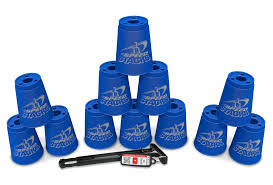
Cup stacking, also known as sport stacking, has become a regular activity in many physical education classes around the United States.
More than 5,000 American schools now include stacking in their curriculum, including mine.
But where did this odd addition to the curriculum originate?
It began when Bob Fox, an ex-clown-turned-teacher, purchased $43,000 worth of dead-cup inventory — his life savings — from a Tokyo warehouse to sell to sport stacking enthusiasts, who did not yet exist.
Each unit consisted of 12 cups, with holes drilled in the bottom.
120,000 cups in all.
The dream:
Convincing thousands of kids that stacking these plastic cups in pre-determined patterns was fun.
Even more challenging:
Convince the parents of those kids to actually buy these cups, even though the kids can’t drink from them.
And he did. It was a long, arduous journey, with many naysayers along the way, but in the end, Bob Fox turned his supply of cups in something real.
Where once there was no thing, there is no a thing.
At the peak of Sport Stacking, between 2002 and 2011, roughly 5,000 American schools included it in their annual curriculum.
That means somewhere between five and eight percent of U.S. adults between the ages of 22 and 35 share the same core memory, and in the ensuing years have asked themselves, their friends, or social media the same question:
How did credentialed educational professionals come up with this silly physical education activity?
Sport stacking is now a recognized sport, with a governing body (WSSA) hosting competitions worldwide.
Credit a former clown-turned-teacher who saw a chance to purchase a mountain of plastic cups at a bargain-basement price and then built a sport around them.
Sometimes you come up with a great idea, and then you gather the materials to bring that idea to life.
Other times, and probably far less often, you find yourself with a supply of materials and in need of a great idea to make these materials valuable.
Creativity works in many ways.
Entrepreneurism has no pre-determined path.
Inspiration comes in many forms.
Sometimes all it takes is an ample supply of goods at a low, low price and the desire to put them to good use.



This Post Has One Comment
I want to start this game in Africa and particularly in Kenya.
Where can I source used and in good conditions cup stacking.