The family and I saw “A Christmas Story” at The Hartford Stage last month.
In addition to my adoration for Bob Cratchit, I also love Scrooge’s declaration on Christmas morning:
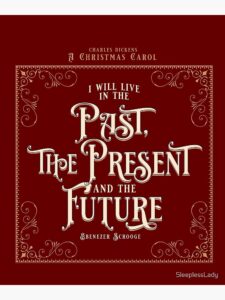
“I will live in the past, the present, and the future!”
I couldn’t agree more, Ebenezer.
But it’s very popular for people to declare or advise that we must live in the present.
Don’t lament the past.
Don’t spend time looking to a future you have not yet created.
As Eckhart Tolle said:
“Realize deeply that the present moment is all you ever have.”
I disagree, Eckhart. I think you are terribly wrong. I think Scrooge has it right.
I am someone who deeply believes in living in the moment. Be attuned and attentive to the present. Embrace everything that is happening around you with as much openness, enthusiasm, and curiosity as possible. I learned long ago, when a gun was pressed to my head and the trigger was pulled, that the moment we have is precious and should be treated as such.
I absolutely try to live in the present as much as possible.
But like Ebebezer, I also believe that the past and future hold enormous value:
The past informs us about who we are. Looking back reminds us of the road we have already traveled. It allows us to hold onto those previous moments we have already lived. It reminds us of how many steps we’ve already taken and how much we’ve already done. It represents our triumphs and defeats. It’s a record of the mountains we’ve ascended and the lessons we have learned.
Hospice workers report that in a person’s final days, one of their most common regrets is not having lived a full life.
I suspect many have led very full lives but can’t remember most of them. It’s how most people live — making no effort to hold on to our memories or maintain the narrative of our lives. When people say time flies or their children grew up so fast, it’s not true.
Time doesn’t fly. It merely gets forgotten.
Those of us who also live in the past cling to our memories because they are unspeakably valuable — see our lives with greater depth and complexity. We don’t end out lives feeling like we haven’t done enough because we can see the expanse of our lives with greater clarity.
Time doesn’t fly nearly as fast.
Our children don’t grow up nearly as quickly.
But looking to the future is important, too. You must set goals if you hope to get to someplace better. You must dream of days more magnificent than there. You must believe in an imperfect, unlikely future that will undoubtedly turn out better or worse than you could possibly imagine, but by setting your eyes on the future, you at least afford yourself the opportunity to play a part in the making of that future, even though fate will almost certainly play a role, too.
I love the moment in “A Christmas Carol” when Scrooge shouts that he will live in the the past, the present, and the future. It’s a tragedy that it has taken him this long in his life — after losing the love of his life and so many moments of possible joy with family and friends — to finally find this wisdom.
So many wasted years worried about petty things at the expense of so much.
But John Cage once said, “Begin anywhere.”
And as Seneca said, “What matters most is not how long you wait, but that you finally begin.”
Good for Scrooge. He has begun. I like to think he’ll live to 150 and have plenty of time to make up for lost time.
And since it’s fiction, he could and might.
I hope your Christmas was a merry one.