I spoke with one of the country’s foremost experts on crows this week.
Crazy, I know.
She told me this story:
Her team of crow researchers had set up a “crow hotline” where people could call and ask questions about crows.
They received calls all the time.
Crows, it turns out, are incredible. They are among the most intelligent non-human animals, with cognitive abilities that rival great apes in several areas. Amongst other talents:
- Crows can solve multi-step puzzles, use tools, and even make tools—for example, bending wire into hooks to retrieve food.
- They can plan actions several steps ahead rather than relying solely on trial and error.
- They have an extraordinary long-term memory, especially for locations and faces. Crows remember where they’ve cached food for months and can recognize individual humans who have treated them well—or badly—years later.
- Crows understand cause and effect. Experiments show they can predict outcomes (like water levels rising when objects are dropped into a container) and choose actions that lead to a desired result.
- They live in complex social systems and can learn from each other, hold “grudges” and alliances, warn others about danger, and pass knowledge across generations. This includes teaching young crows who are dangerous by mobbing specific people and spreading that information socially.
My crow expert was contacted by the Department of Defense at one point to inquire about how effective crows were at facial recognition. They were wondering if they could use crows track human targets.
As a result, people often saw crows do astounding things and called the hotline with questions, thus providing researchers with more information and data.
One evening, while manning the hotline, my crow expert received a call from a woman who asked if crows are spirit animals or maybe even servants of God.
She asked the woman to explain.
The woman had been cross-country skiing in the mountains alone when she fell and broke her leg. Compound fracture. A bone protruding from the skin.
Serious business.
She was five miles from help, and lying in the snow, she thought she would surely die on the mountain unless someone somehow found her. She couldn’t walk, and the pain was excruciating.
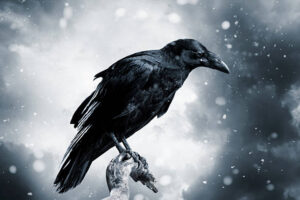
Then she saw a crow standing in the snow a few feet away, staring at her, almost daring her to get going. Save herself.
So she began dragging herself forward. Every time she moved, the crow moved, fluttering a few feet ahead, as if to urge her on.
It took hours of crawling, and the pain was blinding at times, but that crow remained beside her throughout the entire time, and she finally made her way to help.
“That crow saved my life,” she said. “Do you think it meant to help me? Did it know I needed help? Could crows be spirit animals? Do you think it was God?”
The crow expert didn’t have the heart to tell the woman what you might know already:
The crow was waiting for her to die so it could eat her, beginning with her eyes. Crows recognize wounded animals and will follow them for days, knowing a free meal can be had with enough patience.
Here was my thought:
Maybe this is God.
As a reluctant atheist, I don’t believe in a higher power but wish I did, and people over the years have tried to help me believe by telling me stories of when God worked in mysterious ways in their lives.
But maybe all those stories are crow stories.
Maybe they’re all stories about people wanting and needing something, so they see God in the natural world, finding hope and inspiration in something that can be explained through logic and science, unrelated to a higher power.
They see what they need to see. Then they call it God.
That woman needed inspiration in a time of desperation, so she found that inspiration — and God — in a crow.
In truth, the crow just wants to eat her. It’s waiting to tear her flesh from her bones. But people see what they need to see, either by rejecting facts we know to be true, or perhaps more often, not knowing the facts at all
Had this woman known that crows wait for wounded animals to die, perhaps she would’ve seen something entirely different:
A predator waiting for her to give up. An animal hoping for her eventual surrender and demise.
She might’ve called the crow the Devil and been equally inspired to save herself.
I’m still someone who would like to someday believe in God, but this crow story has me thinking a lot about what God might be:
A bigoted, sentient entity who made his first three Commandments all about himself and thinks we should murder people who work on Sunday…
… or a simple bit of nature filled with imagined but much-needed meaning.