Every summer and during the Christmas holiday, Howard Marks, the co-founder of Oaktree Capital Management, writes a memo for all to see about his investment strategies for the upcoming season.
Marks doesn’t hold back. He is honest and forthcoming, detailing what his company will be doing over the next few months and years. Warren Buffett of Berkshire Hathaway pays close attention to Marks’s writing, saying, “When I see memos from Howard Marks in my mail, they’re the first thing I open and read. I always learn something, and that goes double for his book.”
Recently, on David Perell’s podcast, Perell asked Marks why he would share his secrets with his competitors. Marks said he didn’t feel he was giving away too much and that the secret to success isn’t knowing his concepts, but instead implementing the strategy, which most people won’t do. Either they can’t, or they are unwilling.
What Marks is counting on with the freedom of his information is that most people, even those with the highest levels of intelligence, cannot apply the knowledge.
When I published “Storyworthy” back in 2018, my friend Kathy told me I had just hurt my chances of winning storytelling competitions at The Moth.
I had given away all my secrets.
I had offered a blueprint for better storytelling.
I had leveled up my competition.
Admittedly, I’ve been beaten in Moth GrandSLAMs twice by stories I helped the storytellers craft, which isn’t fun. Listening to an audience roar with laughter at a joke you gave a storyteller, or listening to them gasp at a surprise I made happen, stings a bit, but that is very different from offering strategies and tools for storytellers to tell better stories.
I wasn’t worried. Experience, commitment to the craft, innovation, flexibility, adaptability, confidence, and more would still help me win the day.
Happily, that book also opened the doors for me to places like Microsoft, Amazon, Google, Smuckers, Slack, and even the FBI.
But I also agree with Marks:
Providing a blueprint doesn’t mean everyone will elevate their game to my level.
Seven years afterpublication, I did some analysis:
Before “Storyworthy” was published, I competed in 66 Moth StorySLAMs and won 33 — a 52% win rate.
After publication, I competed in 56 Moth StorySLAMs and won 30 — a 53% win rate.
So I’ve actually improved my performance since the book was published.
In terms of Moth GrandSLAMs, the results were similar:
Before publishing “Storyworthy,” I competed in 21 Moth GrandSLAM championships, winning six — a 29% win rate.
After “Storyworthy,” I competed in 17 Moth GrandSLAM championships and won four — a 24% win rate.
So I’ve performed slightly worse in championships since the book was published, but the sample size is smaller, and if just one of my NINE second-place finishes since publication had been a first-place finish, my win rate would’ve increased.
In short, Kathy was wrong. I didn’t lose my edge upon writing the book.
One caveat:
I’m constantly reminding people that it’s impossible to measure lost potential, meaning it’s possible that had I not published Storyworthy, my win percentages could have been exceedingly higher. I didn’t lose an edge by publishing the book, but perhaps I denied myself the opportunity to do even better.
I absolutely don’t think this is the case here, but I need to acknowledge that possibility, as I believe we all should when dealing with outcomes.
But even if my winning percentages in competitions have decreased since publishing the book, I would’ve been perfectly fine with this. I’m a teacher at heart, so helping people improve performance is something I believe in and love doing, so losing a little more often to help others would be an easy price to pay.
Also, “Storyworthy” has changed my life. It’s become a bestselling book that has opened doors for me at companies, universities, government institutions, and many other places. Fewer Moth StorySLAM victories would be a small price to pay for the opportunity to do the work I do today.
Happily, that has not been the case.
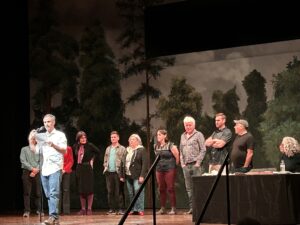
Last week I won my 63rd Moth StorySLAM and my tenth Moth GrandSLAM championship.
I’m still competing and winning at The Moth, despite the book. And if my words of wisdom help my competitors tell better stories, I’m happy.
I’m a teacher first and a storyteller second.