In 1989, I moved out of my childhood home and into a townhouse in Crystal Village in Attleboro, Massachusetts, with my friends Bengi and Tom. We called our home The Heavy Metal Playhouse, and for the next three years, we had a lot of fun while living in poverty and perpetual uncertainty.
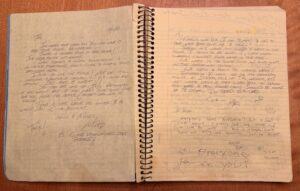
We kept a communication log in a wire-bound notebook that Bengi blessedly saved.
He passed it onto me earlier this year, so I have begun reading it.
Last week, I read the first page. Today I turned that page and read the next two.
At the bottom of the first page — in a note by my roommate Bengi — he wrote “Turn page” in parentheses. I assumed the following page would contain a postscript of some kind, but instead, when I turned the page this morning, I found a note from me, entirely in capital letters, which is how I wrote back then.
Terribly inefficient.
It’s odd to find a 37-year-old note, written by me months after graduating from high school and living on my own, absent any safety net or adult counsel.
It’s me, but it’s also a different version of me.
Happily, I like this version, too.
This note is for our roommate, Tom, mostly to remind him to be responsible.
I tell him to clean up after himself. “A clean townhouse is a happy townhouse.” I also tell him that although Bengi offered him a leftover brownie, there are also apples in the refrigerator, which is a healthier choice.
“Have a safe drive to work and have a great day!”
I’m 18 years old, but I sound like his mother.
Plus, I add a postscript:
“Close the dishwasher door, please!”
I sign my letter with “Hugs and kisses.”
I was either super annoying back then or incredibly responsible.
I also tell Tom, with great aplomb, that we have a laundry room somewhere in the complex but have yet to locate it.
On the adjacent page is another letter I wrote to both Bengi and Tom the next morning. It includes an update on how far I’ve gotten in the Teenage Mutant Ninja Turtles game we’re playing on the Nintendo.
I recall this being a serious piece of business for all of us.
I also apologize for waking them up in the predawn hours while getting ready for work. I discuss needing a rack to hang our keys because I lose them all the time, and I implore us to organize the bathroom soon.
But the most interesting part of my note is a reference to needing to drive to Eastland Bank in Woonsocket later that day to pay my loan. After a near-fatal car accident almost a year earlier during my senior year of high school, my step-father forced me to take out a $5,000 loan to pay for the car that I had totaled in a head-on collision that sent my head through the windshield and required CPR to restore my life.
The car was my mother’s 1978 Datsun B-210. It was eleven years old at the time.
A quick online check indicates the car was probably worth about $500 in 1989, but I paid my stepfather $5,000 for it.
About $14,000 in today’s money.
I was making payments for four years on that loan, and for some reason, I needed to make the loan payment in person on the day of this note, probably because my coupon book was still stuffed into one of the many boxes we had yet to unpack, and I needed to physically make the payment at the bank before it was late.
That loan was a problem for me for a long time. It served as a constant, monthly drain on my already meager salary. When I lost my job and became homeless after being arrested and charged with a crime I did not commit, I fell behind on payments and struggled to catch up when I got back on my feet.
I had forgotten about that loan until now, which surprised me. For a long time, it was an enormous weight on my shoulders. Month after month, I paid that loan but never had anything to show for it.
Seeing it mentioned on the page felt like a punch to the gut:
A reminder of a time when I constantly wondered why I was treated so unfairly.
Below my note is Tom’s first note. He writes that everything looks great in our new home, but he had no time to make lunch, so he plans to buy a “cheap lunch” and bring lunch tomorrow.
Bengi and I must’ve really been forcing him to count his pennies.
He signs it:
XXOO,
Tom
Tom passed away a month ago. Seeing his words on the page, in his familiar handwriting, is both so lovely and so sad.
Beneath his note is one written intentionally in scrawl that reads:
“Hi everyone. How are you?”
Bengi dated it December 11, 1989, at 7:12 AM, alongside the word “Hogleboom.”
Hogleboom was one of the many stuffed animals in our home.
Bengi had the stuffed animal leave a note.
The last thing I noticed was the way my writing has changed over the years. I use a lot of slang that you wouldn’t see me using today. Words like “gotta,” “c-ya,” and “wanna.”
My spelling is solid, and I punctuate well, but this slang looks odd to me today. If you ever exchanged text messages with me, you’d know I often write in complete sentences, with capitalization and punctuation. You’d also never see me using slang.
I’ve never even used a single emoji in my entire life.
This version of Matt, known then as “Matty” (which some people still call me today), played it faster and looser than I do now, and the persistent use of capital letters baffles me.
When and why did this silly, inefficient form of writing start?
But it was another interesting glimpse into my past self, and it brought back lots of memories of a time when everything was new, exciting, difficult, scary, and fun. I so desperately wanted to turn the page and see what happens next, but like the first page, I’ll wait a day or two and savor these moments for as long as possible.