A few notes from my recent posts on my retirement party:
Three people contacted me to express hope that my former school administration will read and heed some of my advice for future teachers.
I assure you that administrators have heard these words from me many, many times. I made a bit of a name for myself over the year for speaking up in meetings, offering pointed feedback, and never shying away from comments that were critical, scathing, and specific.
When praise was in order, I offered that, too, almost always in writing, and almost always directed at the deserving person.
I was also always sure to indicate where this feedback was coming. My school district asked for a lot of feedback, but the feedback forms were designed to allow teachers to provide it anonymously.
No option was given to provide your name.
So I specifically added my name to every bit of feedback, for two reasons:
- I wanted administrators — especially those outside the walls of my school — to know exactly how I thought and felt about their decisions when I disagreed. Anonymous feedback can be ignored and forgotten. It’s like a plastic plant in a waiting room — utterly irrelevant and almost invisible. You need not ever face the source of the feedback if you don’t know their name. When I came face-to-face with the administrators, I wanted them to know that I was the one who made those comments and that I knew they knew it was me.
- I never wanted to be accused of allowing things to stand or only criticizing administrative decisions after I was finished teaching. If anyone ever took the time to access my feedback via the Freedom of Information Act, they would find my name on every bit of it.
In fact, one of my superintendents called me to say that although the feedback I provide is often pointed and critical, they respected me for always attaching my name when no name was ever required.
I used the opportunity to point out that asking employees for feedback anonymously is a sign that your organization lacks psychological safety. Organizations built on trust and transparency do not need to rely on anonymous feedback because employees feel safe speaking their minds to improve the organization.
My superintendent said, “Once again, you’ve provided some pointed and specific feedback.”
Anonymous feedback is still used today.
On a more positive note:
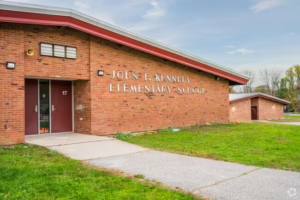
To my surprise, joy, and delight, my former kindergarten teacher commented on my Facebook post about my retirement, which is pretty wonderful and astounding. Fifty years ago, I met Mrs. Dubois in her classroom in John F. Kennedy Elementary School in Blackstone, Massachusetts.
She taught me to read and write.
She began my education in math.
She taught me to love school and adore learning.
I can remember Mrs. Dubois, her classroom, the inflatable letter people, the chalkboard with the alphabet running along the top, and even some of the workbook pages with astounding specificity, probably because she was such a remarkable teacher and I adored her so very much.
I have a copy of “Sun Up,” the first book I read in her classroom. Every year, I would read this basal reader to my students, who delighted in the story’s simplicity and in my memories of reading it when I was five years old.
I can close my eyes and place myself right back into her classroom today.
Desks and chairs in the front of the room.
Tables, blocks, and toys in the back.
Sparkling linoleum floors with area rugs scattered throughout.
A storage closet along one wall that connected to Mrs. Roberge’s room.
A door to the playground at the back of the classroom.
A table outside her classroom where Mrs. Carroll, our kindergarten helper, taught me my phone number, my address, and how to tie my shoes. Three years ago, Mrs. Carroll, who was nearing 100, and I exchanged letters.
I remember it all. Seeing her name on my post congratulating me on my teaching career filled my heart with unimaginable joy.
Things have really come full circle for me.